Blog Agent: An AI Blog Writing Agent That Researches, Writes and Publishes to Your Site
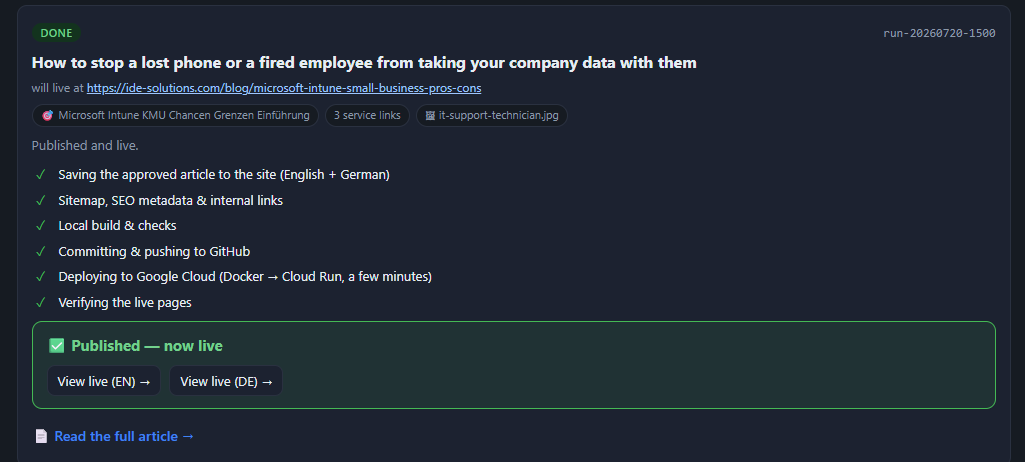
Blog Agent is an autonomous AI blog writing agent with one deliberate human checkpoint. Twice a week it picks the topic itself, writes the complete article in English and German, wires up every piece of SEO metadata your site needs, deploys it live and verifies the result. Your only job is to read one finished draft and click Publish. It is not a chat window you paste prompts into, and it is not a generic AI content generator that hands you text and stops.
The Problem It Solves
Every business knows it should blog. Almost none of them do. Companies that publish useful content get found on Google, get quoted by AI assistants, and get taken seriously by buyers comparing three suppliers. So you set up a blog, published four posts in the first month, and then work got busy. The last article is eighteen months old and it quietly tells every visitor that nothing much happens here. The reason is never motivation. Publishing one good article is not one task, it is nine: find a topic worth writing about, check you have not already covered it, write 1,500 words a customer would actually finish, write it properly in German, pick an image, write the meta title and description, add the page to the sitemap with the right hreflang tags, add structured data, link it from existing pages so it does not sit orphaned, and deploy without breaking anything. Miss one step and you get a 404, a page Google never indexes, or a German version that never appears.
What Automated SEO Blog Publishing Actually Means Here

- It picks the topic itself: the agent pulls fresh material from the sources that matter in your industry, ranks candidate stories by relevance to what you sell, and picks the strongest one. No content calendar to maintain and no prompt to compose. Hand it a URL instead and it builds the article around that story.
- It never repeats itself: before writing it reads every article you published in the last six months, by title and by topic, and discards any angle that overlaps something already covered. Duplicate content is checked automatically rather than remembered manually.
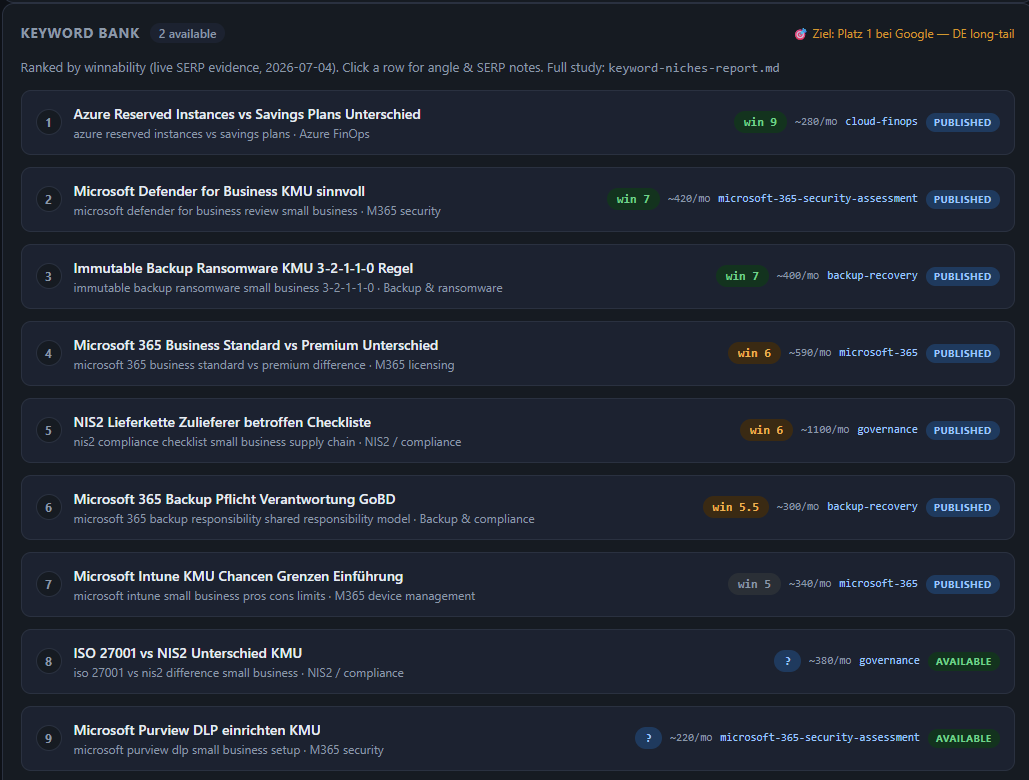
- Keyword targeting with a winnability score: the agent works from a ranked bank of keyword targets scored on live SERP evidence, not estimated difficulty. Terms owned by Microsoft and Amazon are marked unwinnable and skipped in favour of long-tail terms held by companies your size. Each article claims one target and the bank updates on publish so nothing is targeted twice.
- Bilingual content written, not translated: every article ships in English and German, each meeting the same 1,500-word minimum independently. The German version is written natively in proper business register. Machine translation quality is the usual tell that content was automated, and this avoids it.
- Internal linking in both directions: each article carries at least three contextual links into your service pages, placed inside the prose where they answer the problem being described. The agent also adds links from two or three existing pages into the new article, so it is connected from day one instead of sitting orphaned.
- Complete SEO wiring: sitemap entries with the correct hreflang set, per-language meta titles and descriptions, JSON-LD structured data for rich results, the language routing map and the crawler-visible version of the page. Search engines are then notified directly through IndexNow.
Why an AI Content Agent Beats a Generic AI Writer
Most AI content tools stop at the text. That leaves the nine-step publishing job with you, which is the part that actually consumes the working day. Blog Agent runs the whole pipeline: research, topic selection, deduplication, keyword claiming, drafting in two languages, editing, internal linking, metadata, sitemap, structured data, build, commit, deploy, search engine notification and post-deploy verification. A freelance writer costs 300 to 800 euro per article and doubles for a second language, so a modest two-post month runs 1,200 to 3,200 euro, and you still brief them, review the draft and do the technical publishing yourself. An agency retainer removes the writing but adds a monthly fee, a slower turnaround and articles that read like everyone else's.
Writing a Human Would Sign
There is a hard style contract behind every draft. Articles lead with the business problem, never the acronym, because a business owner will not click a headline that opens with "Conditional Access". Technical terms are introduced only after the plain-language hook and explained in one sentence. A banned-phrase list strips the tells that make text read as machine-generated, and a dedicated editing pass runs over both language versions before anything reaches you. Concrete numbers, short sentences, no hype.
Quality Gates That Can Block Your Own Deploy
Before anything ships, the agent checks its own work: minimum word count in both languages, at least three service links in each, meta description within limits, keyword actually present on the page, unique post ID, matching metadata across languages, complete sitemap coverage and a clean production build. Any failure stops the deploy. It fixes and re-checks, and if it cannot, it reports the problem instead of shipping something broken. After deployment the agent fetches the live pages and confirms the article body is there, the language tags are correct, the German URL returns a working page and the sitemap contains the new entries. If any of that fails, it reverts the change and redeploys the previous version rather than leaving a broken page up.
Nothing Goes Live Without You
There is no fully unattended mode, deliberately. Every article stops at a human review and waits, and the agent will not start a second article while one is awaiting your decision, so nothing piles up behind your back. The dashboard shows a rendered preview of both versions, styled exactly like your live blog, with the URLs each will get. You press Publish, or you press Request edits and type what you want changed in plain language. Edits come back revised with every quality rule re-checked, and there is no limit on revision rounds. Approved text is copied to your site word for word; the agent does not rewrite what you approved.
Architecture and Data Handling
The agent performs exactly one action per invocation and holds all state in versioned JSON on disk. There is no long-running server to keep alive and no session to lose, so any invocation can be interrupted and the next one resumes correctly. A lock file with a time-based expiry guarantees runs never overlap, and a run that fails twice surfaces in the dashboard with its log rather than appearing frozen. Articles are stored as Markdown with structured frontmatter and semantic HTML bodies, committed to your repository. Changes are pushed to your Git remote, built as a container and deployed to Google Cloud Run in the EU region. The agent works against your own repository and your own cloud project, so the repository and the credentials stay in your infrastructure. Drafting runs on Anthropic’s Claude models; what the model sees is set out on the security page. There is no third-party content platform in the middle and no vendor lock-in: everything it produces is plain files that remain yours and fully editable by hand.
Who It Is For
Small and mid-sized companies that need to publish consistently in English and German but have nobody whose job it is. It fits best if your site is a file-based blog in a Git repository with a container deployment, which covers most modern marketing sites. We assess fit before quoting, and if you are on a hosted CMS we will tell you honestly whether it is a good match. Three deployment options exist: self-hosted on a machine you control, deployed and configured by us and then handed over, or fully managed, where we run the infrastructure, tune the sources and refresh the keyword bank quarterly while you just approve the drafts. The options are compared on the pricing page. Contact us to book a demo. For tenant-wide accountability over mailboxes, Teams and service accounts, see our Ownership Registry.
Deployment Options and Pricing
| Option | Where it runs | Infrastructure cost | Setup | What's included | Licence |
|---|---|---|---|---|---|
| Self-hosted | A machine you control, publishing to your own repository | Your own compute plus model API usage | You install and configure it against your site | Full ownership of every article and every file it writes | On request |
| Deployed by us | Your infrastructure, configured and handed over by us | Your own compute plus model API usage | We install it, tune the sources and build your keyword bank | Configuration, source tuning, keyword bank, handover | On request |
| Fully managed | Our infrastructure, publishing to your site | Included in the managed service | We assess fit, then set up everything and start the schedule | Infrastructure, source tuning, quarterly keyword refresh, two articles a month in both languages | On request |
Licensing is quoted on scope: tenant size, how many locations you run, and whether you operate it yourself or we do. A demo runs against your own environment and takes 30 minutes, with the quote following in the same week. Book a demo or request a quote.
Frequently Asked Questions
Does it publish anything without me seeing it?
No. Every article stops at a human review and waits. Nothing goes live unread.
Does it read like AI-generated content?
It is written under an explicit style contract designed to prevent exactly that: no em dashes, no stock AI phrasing, no filler patterns, plain verbs, concrete numbers and short sentences. A dedicated editing pass runs over both language versions before you ever see the draft.
Can I still write articles myself?
Yes. Everything it produces is a normal file in your repository. You can edit published articles by hand, write your own alongside them, or stop using the agent entirely and keep every article it ever wrote.
How long until I see results in search?
Search engines are notified at publish time, so articles are typically discovered within hours instead of weeks. Ranking is slower and depends on your domain and your competition, which is exactly why the keyword bank scores targets on winnability rather than volume. Expect movement on long-tail terms in the first few months and treat it as a compounding asset, not a switch.